21.09.2026
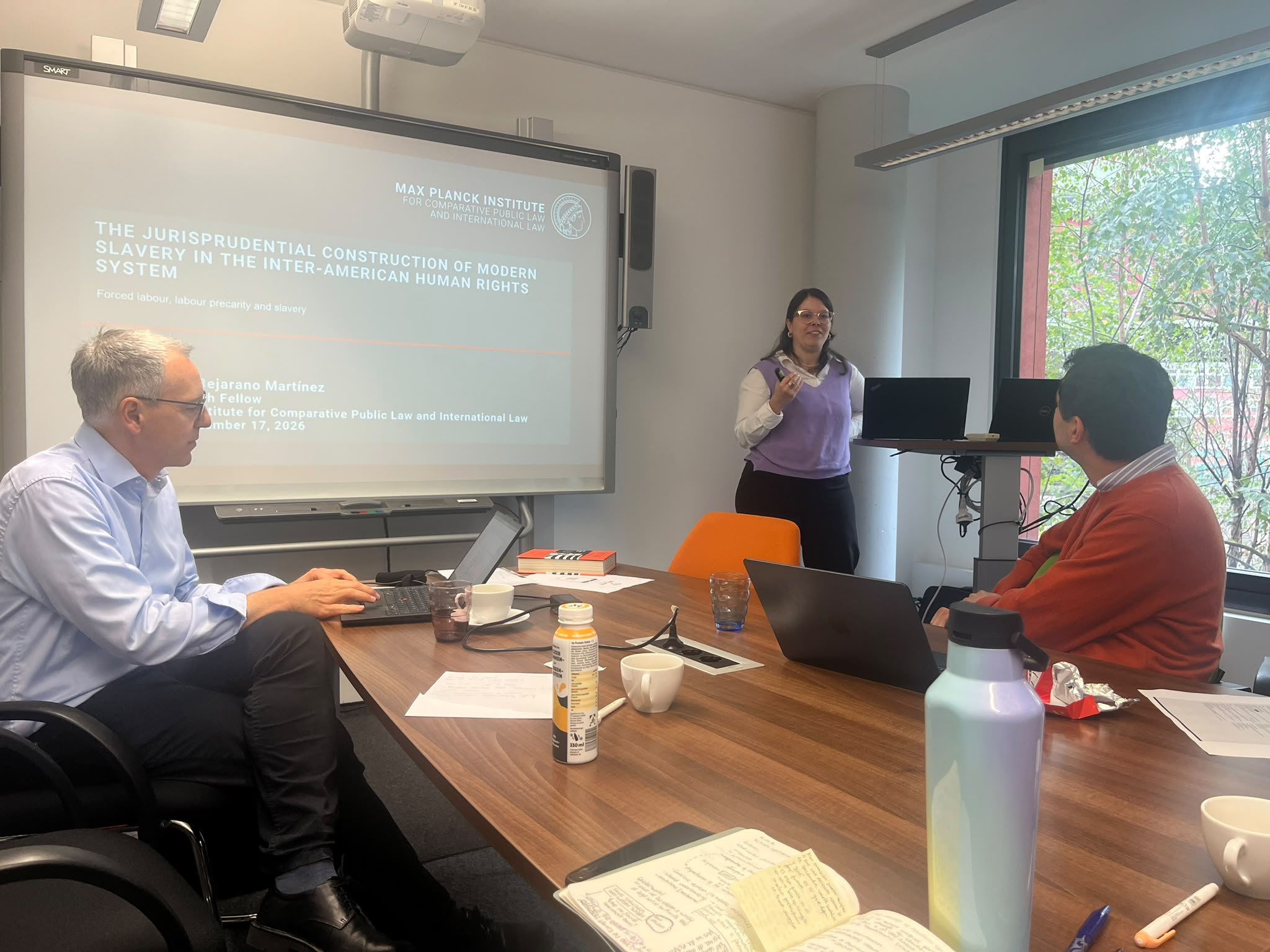
Carolina Bejarano Martínez presents on the conceptualization of modern slavery in the Inter-American System
On September 17, Carolina Bejarano Martínez, Senior Research Fellow at the Max Planck Institute for Comparative Public Law and International Law and Academic Coordinator of the ICCAL Collaboration Lab, presented on "The Jurisprudential Construction of Modern Slavery in the Inter-American Human Rights System" at the international conference "Contemporary Slavery, Human Rights & Socio-Environmental Justice", held at the Centre for Global Cooperation Research in Duisburg.
The conference was organized by Saulo de Matos (Universidade Federal do Pará) and Andreas Niederberger (University of Duisburg-Essen). It brought together philosophers, legal scholars, and researchers from Germany, Brazil, and Ghana across four panels addressing contemporary slavery in global supply chains, its treatment in philosophy, history, and law, and the forms it takes in domains as different as urban construction in the Legal Amazon and forced recruitment by non-state armed groups.
From two lines of jurisprudence to a norm in circulation
The presentation traced how the Inter-American system arrived at a concrete concept of modern slavery. Its central argument is that this concept was not defined in a single judgment, but built up over time through two lines of jurisprudence that, for years, did not engage with one another. The first line recognized slavery and servitude within contexts of mass violence, in cases such as Masacres de Ituango vs. Colombia and Masacres de Río Negro vs. Guatemala. The second developed a detailed vocabulary on structural labor exploitation through Article 26 of the American Convention, in cases such as Empleados de la Fábrica de Fuegos vs. Brasil and Buzos Miskitos vs. Honduras, without ever naming slavery as such.
Her presentation identifies Hacienda Brasil Verde vs. Brasil as the turning point where the two lines converged while highlighting the earlier role of the Inter-American Commission through reports and friendly settlements such as José Pereira vs. Brasil.
The closing section returns to ICCAL’s concept of impact, understood not as compliance with a ruling but as the circulation of interpretive standards within a shared regional legal corpus. The case Bejarano used to underline this argument was the Furukawa ruling, in which Ecuador’s Constitutional Court applied Inter-American criteria to recognize a situation of modern slavery and order structural reparations — even though Ecuador was by no means involvend in the Hacienda Brasil Verde case.