30.09.2026
Twenty years of conventionality control: Max Planck Institute co-organises international conference at UNAM
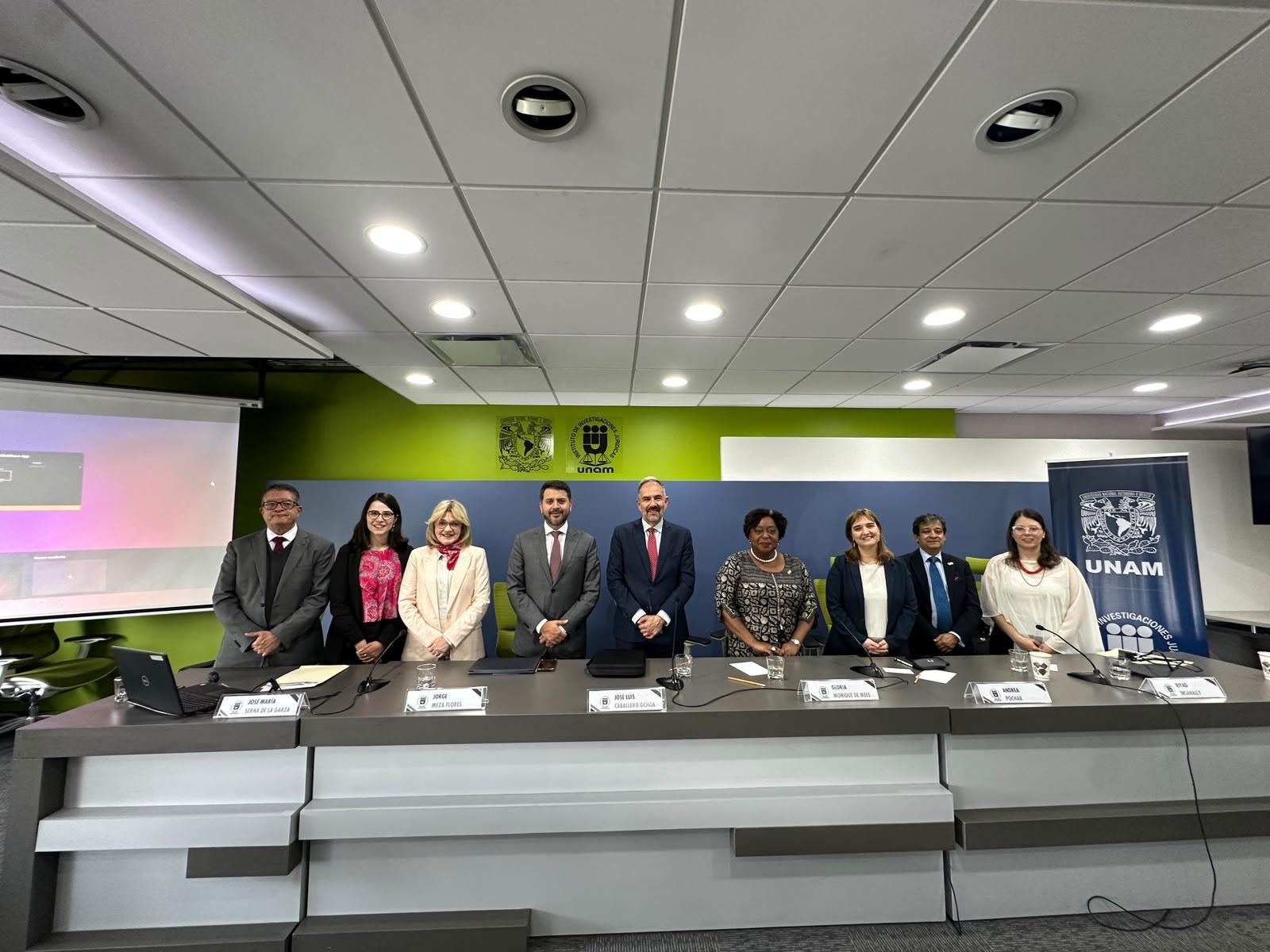
On 29 and 30 September 2026, the Institute for Legal Research (IIJ) of the National Autonomous University of Mexico (UNAM) hosted the international conference "20 years of conventionality control: contributions and challenges for safeguarding human rights in the region" in Mexico City. The event commemorated the judgment in Almonacid Arellano et al. v. Chile. The Max Planck Institute for Comparative Public Law and International Law (MPIL) co-organised the conference together with the IIJ, its Observatory of the Inter-American Human Rights System (OSIDH) and the Ibero-American Institute of Constitutional Law. MPIL senior research fellow Mariela Morales Antoniazzi sat on the academic committee alongside María Elisa Franco Martín del Campo, José María Serna de la Garza, Eduardo Ferrer Mac-Gregor and José Daniel Chávez. Her MPIL colleague Carolina Bejarano Martínez was among the speakers.
Inter-American Commission at the heart of the debate
Five panels brought together members of the Inter-American Court and Commission with experts from across Latin America. They examined the origins of the doctrine, its relevance for groups in vulnerable situations and its application in different countries. The Inter-American Commission had a strong presence throughout both days. Panel 1, on regional progress and challenges in conventionality control, featured its President, Edgar Stuardo Ralón Orellana, and its Executive Secretary, Tania Reneaum. Panel 3, on protecting vulnerable groups, included First Vice-President Andrea Pochak, Commissioners Gloria Monique de Mees and Riyad Insanally, and Assistant Executive Secretary Jorge Meza Flores. Second Vice-President José Luis Caballero Ochoa took part in Panel 2.
Conventionality control at the core of ICCAL
At the opening session, Morales Antoniazzi placed the conference within the framework of Ius Constitutionale Commune in Latin America (ICCAL). She presented ICCAL as a concept, a body of norms and a research network that combines theory and practice to advance the transformative potential of human rights, democracy and the rule of law in the region. Within this approach, she explained, conventionality control forms the doctrinal core. By fostering dialogue between national and inter-American judges, it drives "inter-Americanisation": standards developed in San José permeate domestic legal orders and lead to legislative reforms and new public policies. She then traced how the range of authorities bound by this review has steadily widened, from the judiciary in Almonacid to all public authorities in Gelman v. Uruguay (2011). Its benchmark has likewise expanded to the entire inter-American corpus iuris, including advisory opinions. She cited human trafficking, a crime rooted in inequality and linked to corruption, as a case in which the whole state apparatus must act in line with regional standards. She closed by recalling Sergio García Ramírez, who held that conventionality control should be "a factor of legal harmonisation, not a seed of dispersion".
Tribute to Sergio García Ramírez
Later that day, Morales Antoniazzi spoke on Panel 2, devoted to the contributions of the former Mexican judge of the Inter-American Court. She shared the panel with José Luis Caballero Ochoa; José de Jesús Orozco Henríquez, IIJ researcher and former member of the Inter-American Commission; and María Elisa Franco Martín del Campo, coordinator of OSIDH.
Her presentation paid tribute to García Ramírez. The concept first emerged in his reasoned opinions, beginning with Myrna Mack Chang v. Guatemala (2003), and Almonacid later turned it into an obligation for domestic judges. Morales Antoniazzi described the doctrine as a theory built case by case and as a driving force behind ICCAL. She identified four challenges: legitimacy, operability, systemic coherence and political context. She also transposed to the regional level the scenarios of continuity, atrophy and rupture that Armin von Bogdandy outlines for European Union law. In her view, amid announced withdrawals, financial pressure and penal populism, the system’s resilience depends largely on domestic courts, which conventionality control has turned into its last line of defence.
A bridge to dignity
In Panel 4, which focused on the Inter-American Court’s perspective, Carolina Bejarano Martínez spoke alongside Verónica Gómez, a judge of the Court; Pablo González Domínguez, its Director of Legal Affairs; and Yuria Saavedra Álvarez, professor at UNAM’s Faculty of Law. Her presentation, "A bridge to dignity", proposed replacing the images of pyramid and supremacy with that of a bridge: one that links two banks without subordinating either, can be crossed in both directions and leads to human dignity. Drawing on the Preamble and Articles 1(1) and 2 of the American Convention, she presented the mechanism as a means of preventive adaptation. Building on the 2013 compliance-monitoring resolution in Gelman v. Uruguay, she also distinguished between res judicata and res interpretata. She argued that criticisms of a democratic deficit and of backlash lose force once the hierarchical logic is set aside, although the model requires the Court to give rigorous reasons and remain open to dialogue with domestic judiciaries.
The conference ended with a panel on progress and challenges of conventionality control in Mexico, followed by closing remarks from IIJ Director Mónica González Contró, José María Serna de la Garza, Mariela Morales Antoniazzi and María Elisa Franco Martín del Campo.