24.09.2026
Carolina Bejarano Martínez highlights the role of Colombia’s Constitutional Court at XXI Encuentro de la Jurisdicción Constitucional
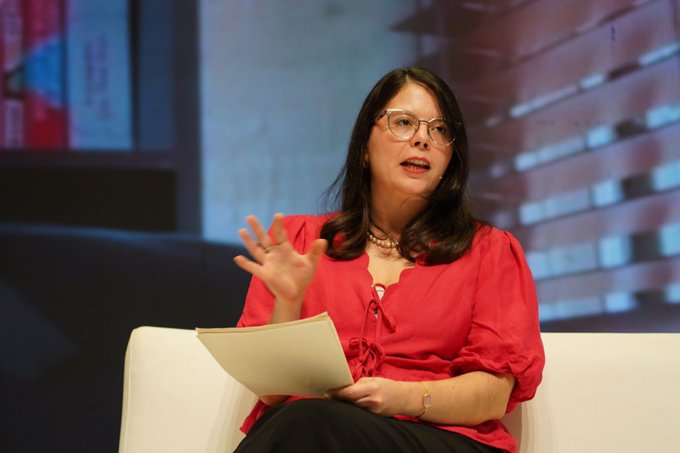
On 24 September 2026, at Teatro Santander in Bucaramanga, Carolina Bejarano Martínez, senior research fellow at the Max Planck Institute for Comparative Public Law and International Law (MPIL) and academic coordinator of ICCAL Lab, spoke on the panel "A conversation on jurisprudential exchanges between national and regional courts". The panel was part of the 21st Constitutional Jurisdiction Meeting (XXI Encuentro de la Jurisdicción Constitucional), hosted by Colombia’s Constitutional Court. Justice Lina Marcela Escobar Martínez moderated the discussion. Bejarano Martínez was joined by Professor David Bilchitz of the University of Johannesburg (South Africa) and Judge Stacie Beckerman of the US District Court for the District of Oregon. The panel looked at how domestic legal orders engage with regional and international normative systems.
Block of constitutionality: an openness worth defending
In her remarks, Bejarano Martínez argued that Colombia’s Constitutional Court is a beacon for inter-American constitutionalism. This is because of the dialogue it has built with other national courts and with the Inter-American Human Rights System. The legal foundation for that dialogue is the constitutional openness set out in Article 93 of the Colombian Constitution, which underpins the block of constitutionality. For 35 years, she explained, this openness has let constitutional reasoning draw on human rights treaties ratified by Colombia. Those treaties help define the scope of individual rulings and serve as a yardstick for assessing the validity of domestic legislation.
The block of constitutionality also helped give rise to doctrines distinctive to Colombian constitutionalism, such as the unconstitutional state of affairs, structural judgments and the integrated equality test. These doctrines now circulate throughout the region and have made the Court a "beacon among beacons" for Latin American constitutionalism. Bejarano Martínez called for safeguarding this openness and the two-way exchange between national and international levels. That exchange, she stressed, is what has allowed the Court to guide more than the scholars who celebrate its achievements. It has also reached those facing structural inequalities, both at home and across the region.
Regional constitutionalism as a middle-range lens
Asked whether a global constitutional law is viable, Bejarano Martínez acknowledged that international law already takes on constitutional forms, and vice versa. This is one of the key insights of global constitutionalism. She recognised that global constitutionalism is useful for analysing worldwide patterns. Even so, she argued that regional constitutionalism, understood as a middle-range theory, offers a sharper lens. It can still identify patterns, connections and similarities between societies, for instance between Colombia and Brazil, without blurring their cultural and normative differences. To illustrate this, she contrasted democratic erosion in Hungary, which remains subject to European Union law, with faster processes elsewhere, in places that lack this intermediate layer of regional oversight. She conceded, however, that some challenges, notably climate change, demand truly global responses. Those responses can be complemented by regional innovations such as Ecuador’s case law on the rights of nature or the Inter-American Court’s recent advisory opinion on the climate emergency.
XXI Encuentro de la Jurisdicción Constitucional
The panel reflected the wider purpose of the 21st Constitutional Jurisdiction Meeting. Colombia’s Constitutional Court convenes this forum every year, bringing together judges, academics, and national and international experts to foster dialogue between legal systems. The 2026 edition, held from 23 to 25 September under the motto "A Constitutional Court for the world", opened with a ceremony at Parque de las Nieves in Girón. The academic sessions followed at Teatro Santander in Bucaramanga. Topics included current challenges to constitutional democracy, artificial intelligence, judicial independence and the international reach of Colombian jurisprudence.