01.10.2026
Right to democracy 25 years after the Inter-American Democratic Charter: international seminar at UNAM
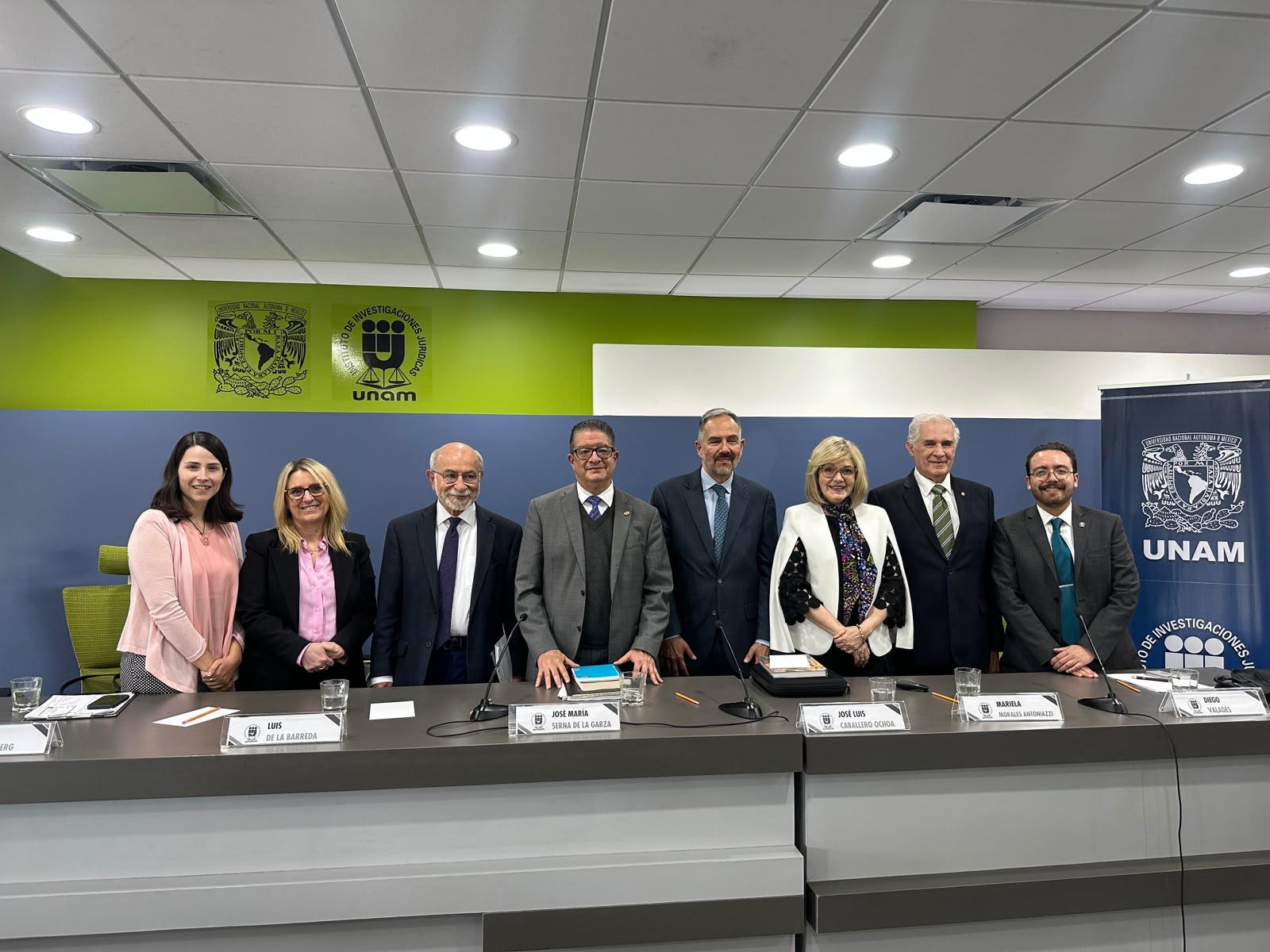
On 1 October 2026, the Institute for Legal Research (IIJ) of the National Autonomous University of Mexico (UNAM) hosted the international seminar "The right to democracy" in Mexico City, marking 25 years since the adoption of the Inter-American Democratic Charter. The Max Planck Institute for Comparative Public Law and International Law (MPIL) co-organised the event together with the IIJ, its Observatory of the Inter-American Human Rights System (OSIDH) and the Ibero-American Institute of Constitutional Law, with the participation of the Mexican Association of Constitutional Law Scholars (Asociación Mexicana de Constitucionalistas). MPIL senior research fellows Mariela Morales Antoniazzi and Carolina Bejarano Martínez were among the speakers.
Three threads for debate: interpretation, content and guarantee
Morales Antoniazzi opened the day by linking the Charter’s anniversary to the request for Advisory Opinion OC-33, submitted by Guatemala, which asks the Inter-American Court whether democracy is an autonomous human right. She framed her remarks around three threads the seminar was to weave together: interpretation, content and guarantee. On interpretation, she explained that the democracy test involves three conditions: the substance of the right is scattered across several provisions, none of them captures it fully on its own, and its neglect affects many rights at once. She illustrated this with the gradual capture of a judiciary. Even if the Court has protected every dismissed judge, no individual claim reflects the collective loss of an independent guarantor.
As for content, she argued that this right goes beyond electoral reductionism, encompassing civic space, judicial independence and safeguards against backsliding. The third thread concerned collective guarantee, which Advisory Opinion OC-26/20 conceives of as an obligation states owe one another, but which currently lies dormant. Finally, she recalled that the ius commune is not the work of a single court but of a community of practice.
Keynote lecture by Humberto de la Calle
Humberto de la Calle Lombana delivered the keynote lecture, with Diego Valadés as discussant and María Elisa Franco Martín del Campo as moderator. De la Calle traced the drafting of the Inter-American Democratic Charter and explained what made its adoption possible in Lima on 11 September 2001. Drawing on that experience, he showed how the Charter can help the region’s democracies tackle the challenges they face today.
Contributions from the Inter-American Commission
The Inter-American Commission on Human Rights was also represented in the discussions. Panel 1, "The right to democracy in the Inter-American Human Rights System", featured José de Jesús Orozco Henríquez, IIJ researcher and former member of the Commission, alongside Jesús María Casal, Eduardo Ferrer Mac-Gregor, María Elisa Franco Martín del Campo and Sonia Rubio Padilla. Commissioner José Luis Caballero Ochoa took part in Panel 2.
From interpreting the Charter to activating it
In Panel 2, "25 years of the Inter-American Democratic Charter: progress and setbacks in the region", moderated by Franco Martín del Campo, Morales Antoniazzi was joined by José Luis Caballero Ochoa; Luis de la Barreda and Flavia Freidenberg of the IIJ; José María Serna de la Garza, president of the Ibero-American Institute of Constitutional Law; and Diego Valadés, emeritus researcher at the IIJ. She argued that the instrument’s main contribution lies in how the Court has developed it. Through case law ranging from Yatama v. Nicaragua (2005) to San Miguel Sosa et al. v. Venezuela (2018), in which the Court described it as an authentic interpretation of the American Convention, the Charter evolved from a political resolution into a legal standard. She also presented the inter-American democracy test, a doctrinal reconstruction she has advanced within ICCAL since 2015. The test rests on three pillars of the Charter: the essential elements of representative democracy, the double conditionality between democracy and rights, and the socio-environmental dimension.
The second part of her presentation turned to the guarantee thread introduced in her opening remarks. Under Article 65 of the Convention, the Court has reported 24 cases of manifest non-compliance to the OAS General Assembly. Drawing on Paula Garat, Morales Antoniazzi proposed three courses of action: more comprehensive reports, a special committee within the Permanent Council and a graduated response to serious breaches. She closed with an image: political science indices provide the map, the test supplies the compass and collective guarantee is the engine. In her view, the challenge for the next 25 years is "to move from a Charter that is interpreted to a Charter that is activated".
Public hearing on OC-33
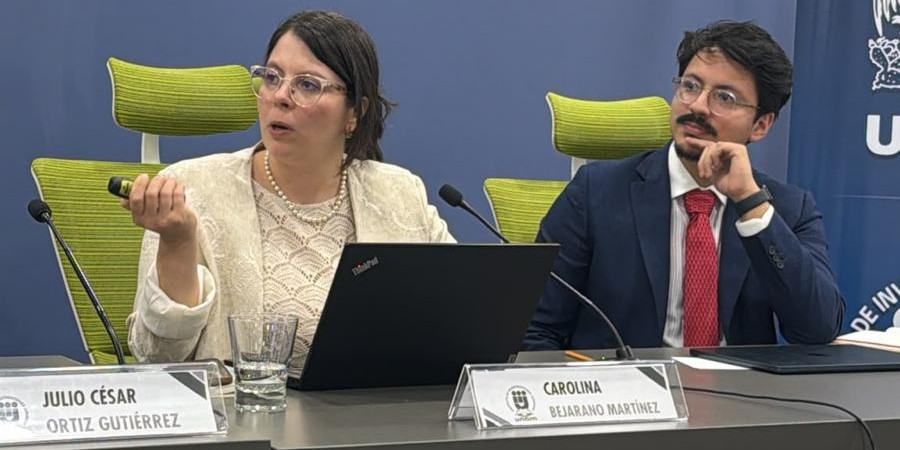
In the afternoon, at Panel 3, "The right to democracy: challenges ahead", moderated by IIJ researcher Jorge Ulises Carmona Tinoco, Bejarano Martínez analysed the public hearing on OC-33 held in Brasília in March 2026. Of the 120 delegations heard, 98 came from universities, non-governmental organisations or private individuals. In her view, this shows that the inter-American community of practice is not primarily a community of governments. She highlighted the participation of national constitutional courts and electoral tribunals, which acted as interlocutors in shaping a regional understanding of democracy. For Bejarano Martínez, the hearing reflects a shift within the system: beyond redressing violations, it now seeks to protect the institutional and collective conditions that make rights possible.