11.11.2026
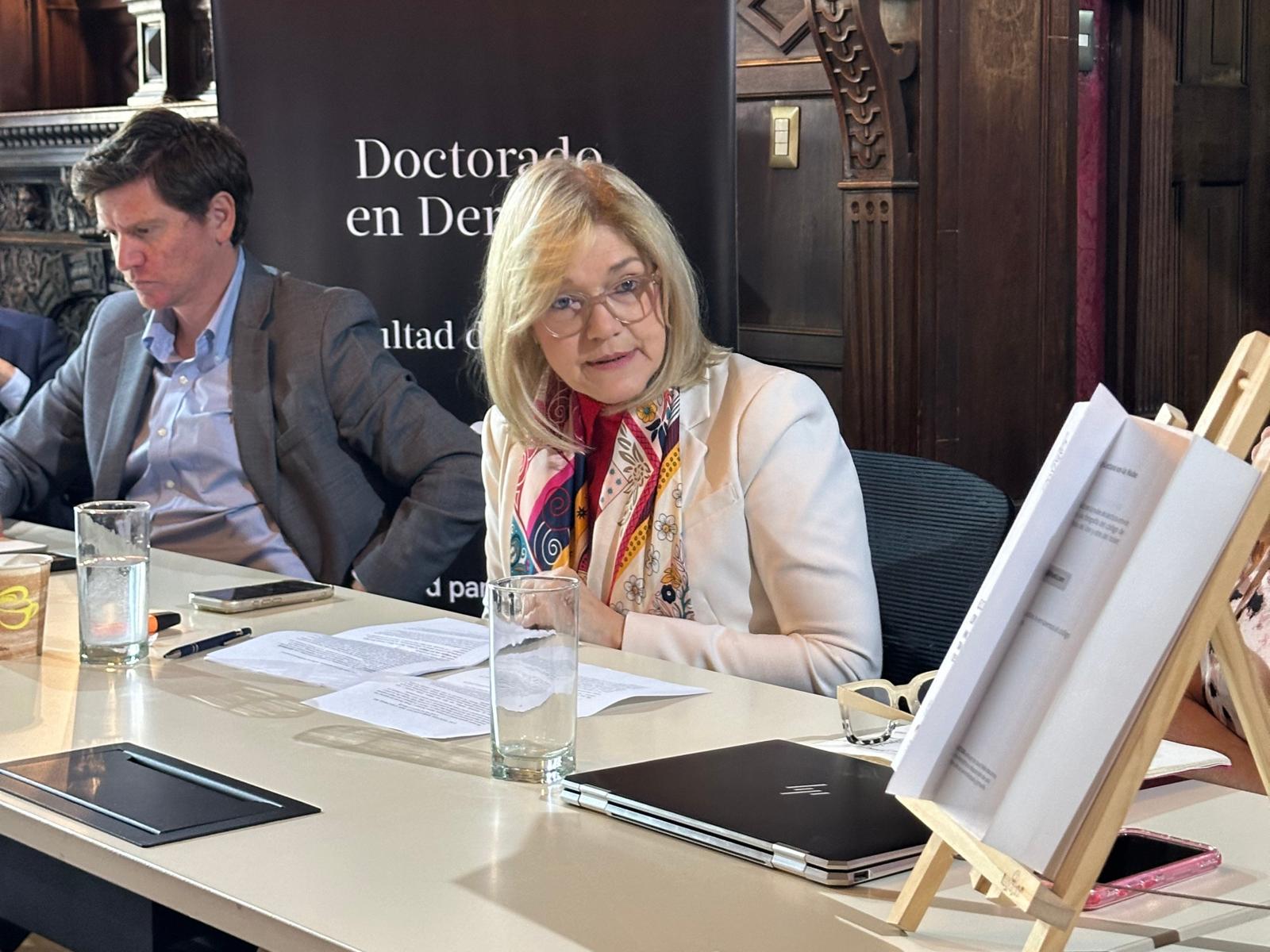
Mariela Morales Antoniazzi presents "El control de convencionalidad. Impacto, transformaciones y desafíos" at Universidad Alberto Hurtado
On 11 November 2026, the Faculty of Law of Universidad Alberto Hurtado (UAH) in Santiago de Chile hosted the presentation of the book "El control de convencionalidad. Impacto, transformaciones y desafíos" (Conventionality control: impact, transformations and challenges), edited by Rodrigo Mudrovitsch, President of the Inter-American Court of Human Rights; Mariela Morales Antoniazzi, coordinator of the ICCAL project at the Max Planck Institute for Comparative Public Law and International Law (MPIL); and Eduardo Ferrer Mac-Gregor Poisot, former President of the Court. At the event, organised by Dean Miriam Henríquez and Professor Tomás Pascual, Morales Antoniazzi explored the doctrine’s new horizons twenty years after the judgment in Almonacid Arellano v. Chile. Pascual and Constanza Núñez of Universidad de Chile presented the key findings of their chapters in the collective volume.
Published by Tirant lo Blanch under the editorial direction of Willy Rodrigo Paz Supo, and made available online with support from the German Agency for International Cooperation (GIZ), the book brings together 47 contributions by 65 authors from 25 countries, among them judges, scholars and members of the human rights community of practice from Latin America, Europe, Africa and Asia. Dedicated to the memory of Sergio García Ramírez, a pioneer of the doctrine, its five parts address the impact, transformations and challenges of conventionality control. The volume had already been launched on 13 October at the seat of the Inter-American Court in Costa Rica.
In her address, Morales Antoniazzi argued that over two decades, conventionality control has become the essential tool for shaping a Latin American ius commune, and that it now also circulates in other regional systems as a functional equivalent. She traced its origins in García Ramírez’s separate opinions, its case-by-case refinement by the Inter-American Court and its reception in domestic legal orders. Since it is the mechanism par excellence for the inter-Americanisation of national legal systems, she concluded, academia has a central role to play in systematising standards, acting as co-creator of the ius constitutionale commune in its epistemic, dialogical and critical function.