20.08.2026
Iberoamerican Colloquiun No. 350: "Ten Years after the Final Peace Agreement in Colombia: The Transitional Justice Model"
Heidelberg, 5 de agosto de 2026
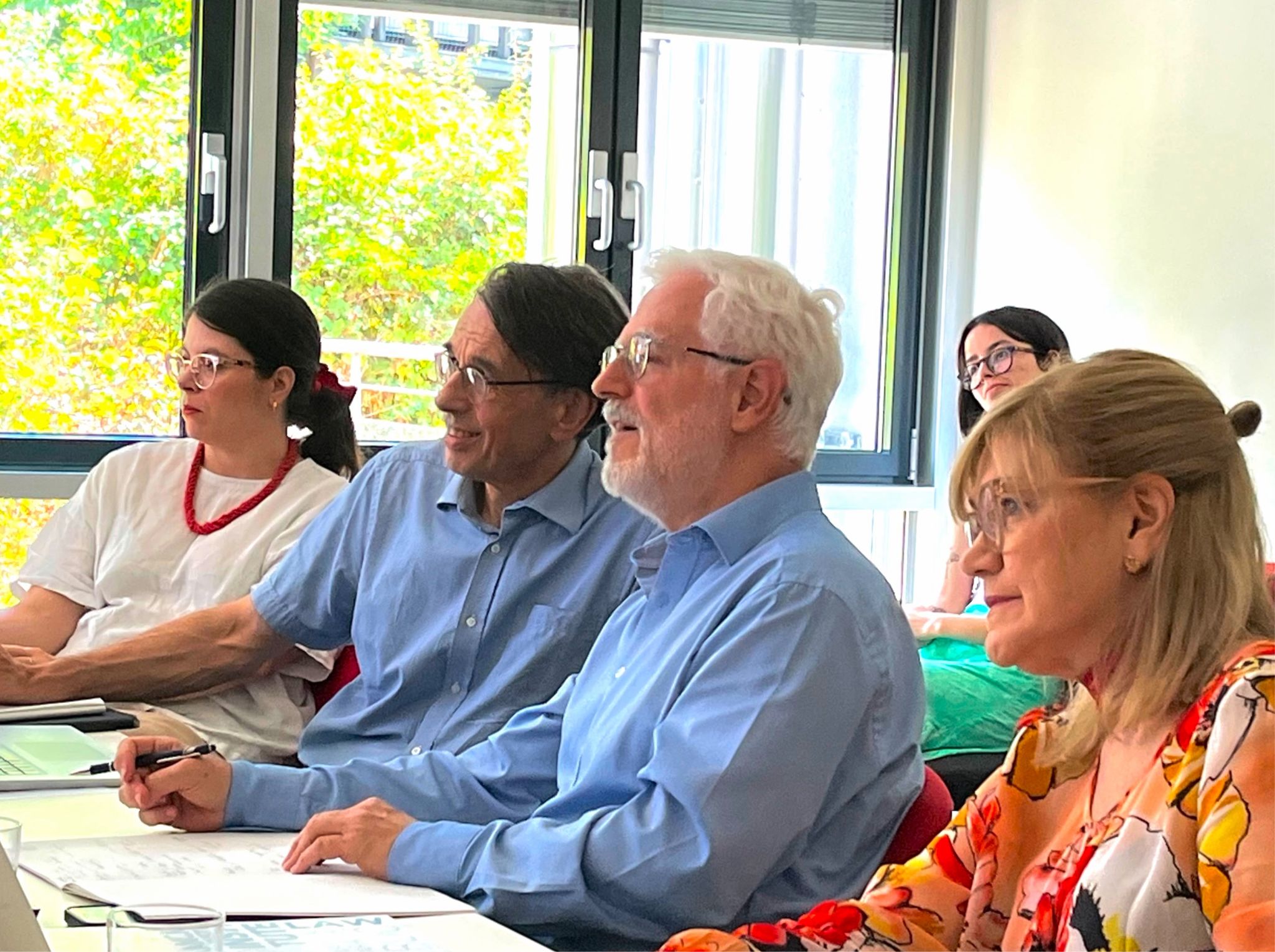
This institute hosted Ibero-American Colloquium No. 350, titled "A Decade After Colombia’s Final Peace Agreement: The Transitional Justice Model." The event invited Rodolfo Arango, magistrate at the Special Jurisdiction for Peace (JEP), for a conversation on the functioning, challenges, and progress of this Colombian transitional justice mechanism a decade after the signing of the Peace Agreement. The discussion was moderated by Armin von Bogdandy, director of the MPIL.
Dialogue between academia and transitional justice
Justice Arango opened the colloquium with a reflection on the importance of dialogue between academia and transitional justice tribunals. He acknowledged that judicial decisions are underpinned by academic developments, and in that sense noted that academia plays a fundamental role in judicial work. His presentation continued with a detailed, schematic explanation of the JEP’s architecture and functioning. The justice addressed the logic behind the macro-cases, the different types of proceedings within the Jurisdiction’s work, the importance and role of victim participation in the process, and gave examples of the tribunal’s own sanctions (sanciones propias).
Truth, victims, and restorative sanctions: the JEP’s innovative character
Throughout the colloquium, Justice Arango emphasized the innovative character of the JEP. On one hand, he highlighted truth as a substantive part of the sanction and of the reparation owed to victims. On the other, and in the same vein, he underscored the centrality of victims and the importance of their participation in the JEP’s functioning. In this sense, both the JEP’s procedural character and the conceptual notions embedded in it — such as its own restorative sanctions — demonstrate the novelty the JEP represents as a transitional tribunal.
A space for collective learning on transitional justice
The presentations acknowledged the challenges involved in judicial work within a transitional justice process. Finally, participants discussed what lessons the JEP might offer for possible transitions in other contexts around the world, such as Venezuela or Togo.
This colloquium reaffirmed the value of these spaces as venues for academic exchange and collective learning, where dialogue among different experiences and perspectives strengthens reflection on the major challenges facing contemporary law and justice.