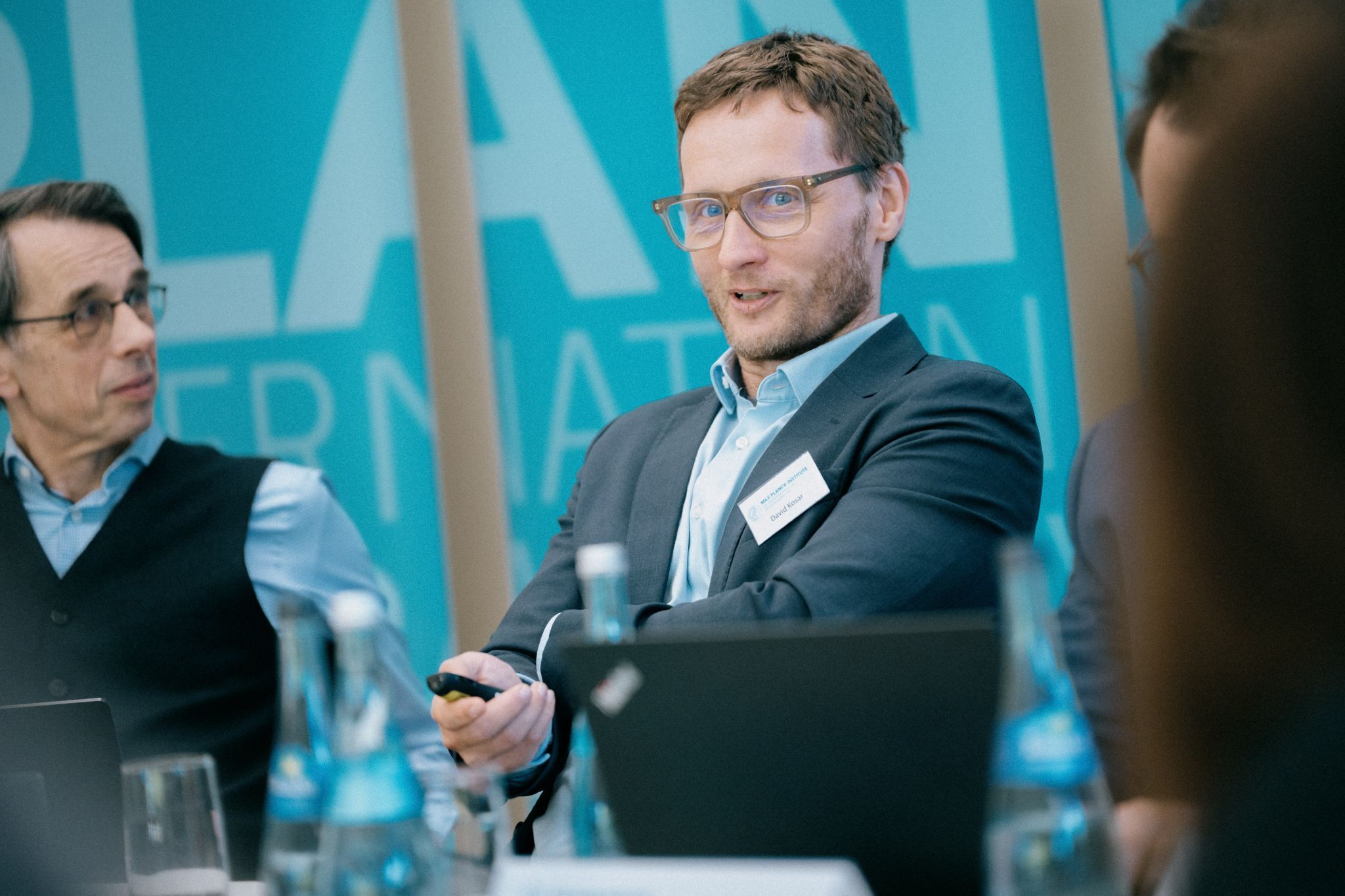
24.04.2026
Transition 2.0 – Hungary: David Kosar on democratic restoration
One of the principal investigators of the COFFIN project participated in the second day of the conference held at MPIL Heidelberg, where participants discussed the legal steps required to restore the rule of law in Hungary within the framework of European law.
David Kosar, Professor of Constitutional Law at Masaryk University in Brno and principal investigator of the COFFIN project at the ICCAL LAB, participated on 24 April 2026 in the conference Transition 2.0: Restoring a Constitutional Democracy in the European Union, organized by the Max Planck Institute for Comparative Public Law and International Law (MPIL) in Heidelberg. The event was convened by Adam Bodnar, Armin von Bogdandy, Pál Sonnevend, and Luke Dimitrios Spieker and brought together legal scholars and political scientists from across Europe to examine how a future democratic government in Hungary could dismantle the illiberal legal order established under Orbán and restore democratic structures within the framework of European law.
Connection with the COFFIN project at the ICCAL LAB
David Kosar’s intervention is closely connected to the research agenda of the COFFIN project at the ICCAL LAB, in which he serves as principal investigator together with Julio Ríos-Figueroa, Andrea Castagnola, and Nino Tsereteli. The project examines whether judicial tenure and judicial autonomy effectively protect democracy against processes of institutional erosion, based on a comparative analysis of developments in Hungary, Poland, Mexico, and Argentina.
In this context, the discussion on the legal instruments available for restoring the rule of law in Hungary engages directly with one of the project’s central research questions: under what conditions judicial reforms can contribute to strengthening democratic resilience.
▶ Video: David Kosar presents the COFFIN project
The broader debate of the conference
The conference addressed Hungary’s constitutional restoration from multiple perspectives. Pál Sonnevend and Adam Bodnar advocated a gradual and legally rigorous strategy of institutional repair rather than a constituent rupture. András Jakab reframed transitional justice as the construction of institutional protection mechanisms against democratic erosion. Beáta Bakó analysed the role of Hungary’s cardinal laws in consolidating political control over the legal system. Marcin Baranski and Kim Lane Scheppele discussed possible accountability pathways compatible with the rule of law.
In the panel on civil society, Márta Pardavi, Edit Zgut-Przybylska, Katarzyna Łakomiec, Barbara Grabowska-Moroz, and Renata Uitz examined the role of organised civil society, women’s rights, and academic freedom as necessary conditions for a genuine democratic transition.