20 August 2026
Cracking down on Dissent in the Name of Peaceful Coexistence: Venezuela’s Hate Speech Law
This blog post was translated from the original Spanish version by using AI tools.
If you encounter any errors, please contact us.
In 2017, the Venezuelan National Constituent Assembly passed the Constitutional Law Against Hate, for Peaceful Coexistence and Tolerance (hereinafter the “law”). The law was presented as a tool to protect society from incitement to hate and violence. Nearly a decade later, this law has become one of the tools used to silence political and social dissent in the country. This blog post revisits the argument from my article on the regulation of hate speech as a double-edged sword and updates it with data from a recent Provea report, which documents 125 cases of violations of freedom of expression in Venezuela between January 2024 and October 2025.
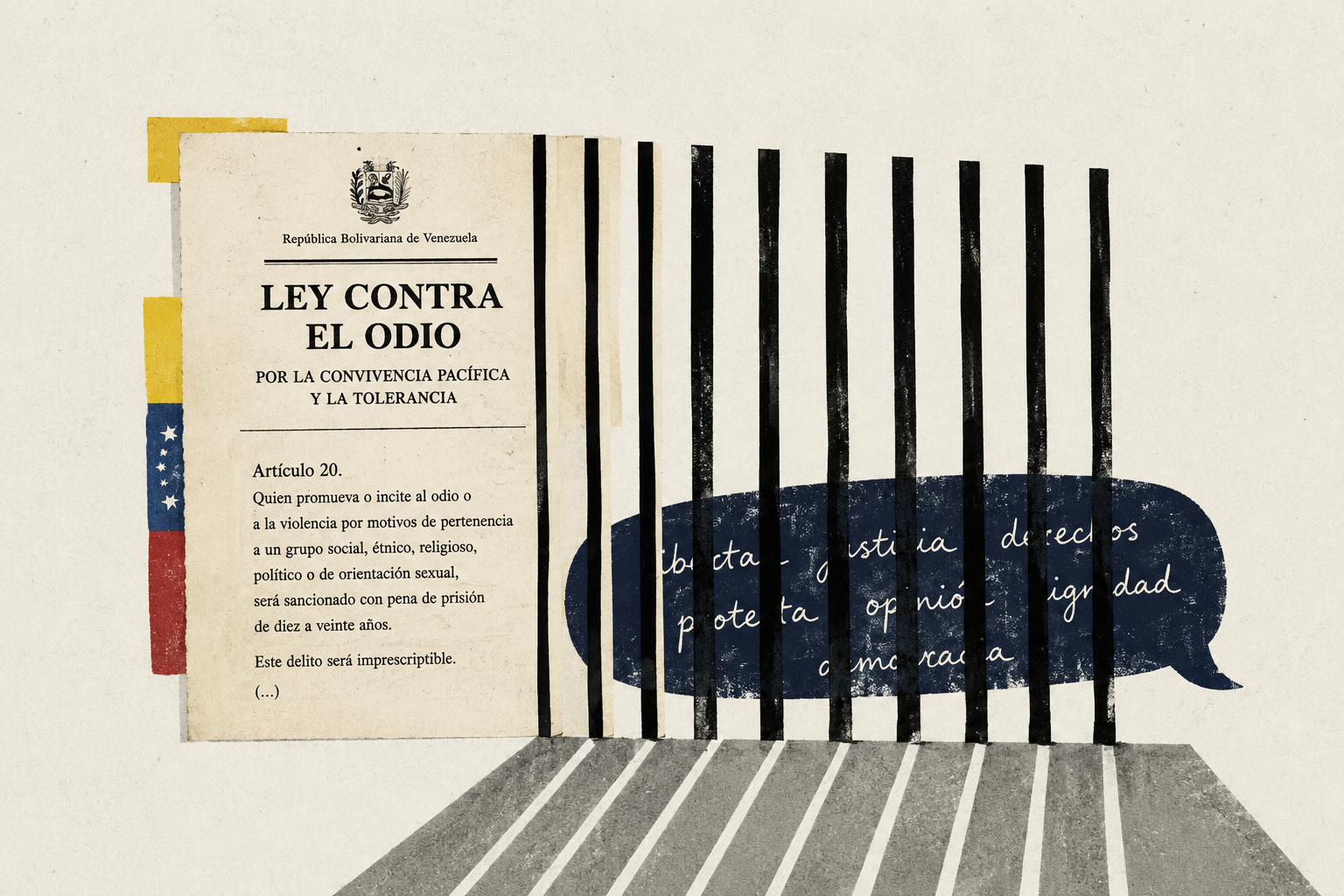
Article 20 of the law punishes anyone who promotes hatred or violence based on membership in a social, ethnic, religious, political, or sexual orientation group with prison terms of ten to twenty years, and declares these crimes to be not subject to the statute of limitations. The law also allows for the revocation of broadcasting licenses and the imposition of fines on digital platforms that fail to remove content identified as inciting hatred within six hours. The underlying problem is not the existence of a law against hate speech, but rather its conceptual vagueness and the consequences of its application. A broad definition, lacking clear standards of legality, necessity, and proportionality, leaves the door open for any criticism of the government to be reclassified as a hate crime.
Article 13(2) of the American Convention on Human Rights requires that any restriction on freedom of expression be established by a clear and precise law, pursue a purpose authorized by the Convention, and be necessary and proportionate in a democratic society. The Inter-American Court applied this standard in the case of Usón Ramírez v. Venezuela, where it found that the criminal offense in question did not comply with the principle of legality due to its imprecise wording. When the Anti-Hate Law was passed, the IACHR’s Special Rapporteur for Freedom of Expression warned that its provisions were vague and broad, and that they allowed for the criminalization of expressions that are legitimate under international law. Human Rights Watch reached the same conclusion seven years later, noting that the law lacks guarantees of legality and proportionality, and that its application has led to arbitrary detentions, censorship, and the criminalization of political dissent. The term “incitement to hatred” is not defined in the law, which allows it to be applied to everything from a direct call for violence to a critical video or a message posted on social media.
My article documented, based on the IACHR’s December 2024 report on the electoral process, how this lack of clarity played out in practice. More than 2,200 people were detained, according to the Independent International Fact-Finding Mission on the Bolivarian Republic of Venezuela, and Foro Penal classified more than 1,580 of them as political prisoners. Charges of incitement to hatred, terrorism, and resisting authority were brought against both opposition leaders and ordinary citizens, including a woman detained in Ocumare del Tuy for writing the word “freedom” on the street with flour.
Provea’s report, Policy of Silencing, published after my article, confirms this trend with a broader empirical basis. Based on 125 cases verified through triangulation of sources, the study records a 48% increase between 2024—with 50 cases—and 2025—with 74 cases in just ten months. The repression is not concentrated in Caracas. The state of Trujillo, in the Andean region, has more cases (19) than the Capital District (18), while Aragua, Barinas, and Zulia each have eight cases.
The report breaks down the repressive measures into 36 arbitrary detentions, 40 criminal charges, 9 cases of persecution, 13 releases from prison subject to restrictive measures, and 3 convictions to more than ten years in prison for crimes of opinion. It also records one death in state custody. Jesús Manuel Martínez, 36, was arrested in Anzoátegui state on July 31, 2024, for disseminating content deemed to incite hatred and died in custody on November 14, according to a report by the Primero Justicia party, due to a lack of medical care. Provea emphasizes that 90% of the cases are marked by a lack of transparency regarding the whereabouts of the detainees, and that only six of the 125 cases were formally reported to national or international bodies.
The report also shows that an undefined criminal offense and its broad application are used to repress union members who denounce corruption in state-owned companies, women’s rights advocates, economists linked to independent monitoring groups, and students who post complaints on social media. The report also documents the issue’s transnational scope. Several Venezuelans deported from the United States were detained and charged as soon as they arrived at Maiquetía Airport for critical content they had posted on TikTok during their exile, and an activist advocating for the LGBTIQ+ community had his passport revoked to prevent him from attending a session of the UN Committee on the Elimination of Racial Discrimination.
Within the Ius Constitutionale Commune in Latin America, Von Bogdandy and others have point out that, while the law can serve as a platform to overcome exclusion, it can also be used as a tool to perpetuate it. The same authors identify Venezuela as a case of curtailed press freedom, restricted political participation, and manipulation of institutions. The Anti-Hate Law illustrates this use of the law. The persecution documented by Provea does not occur outside the law but through it—via a vaguely defined criminal offense, opaque enforcement, and proceedings marked by procedural delays and the denial of the right to defense.
This is a pattern in which the legal language of human rights is co-opted by an authoritarian regime to legitimize the persecution of the opposition. Maintaining a legal ban on hate speech—even in a context of democratic openness—would require, at a minimum, a precise definition of the criminal offense, effective procedural safeguards, and its subordination to the principles of legality, necessity, and proportionality. Without these minimum standards, a law enacted in the name of peaceful coexistence and tolerance can serve as a pretext for persecuting dissent and have the opposite effect, undermining the rule of law and human rights.
Stefania Rainaldi Redon, Cracking down on Dissent in the Name of Peaceful Coexistence: Venezuela’s Hate Speech Law, 20 August 2026, ICCAL Blog, https://iccal.lat/en/blog/venezuela-anti-hate-law-political-repression/
Authors