10. July 2026
The Paradox of the Spanish Transition
This blog post was translated from the original Spanish version by using AI tools.
If you encounter any errors, please contact us.
On January 28, 2026, Marco Rubio formally proposed using the Spanish model as a benchmark for the democratization process in Venezuela. This suggestion invites us to examine the structural characteristics of the democratic transition process in Spain, based on a deeply phased or gradual approach. Far from idyllic visions based purely on immediate rupture, historical experience shows that building a functional democracy required not only specific political victories but also extremely broad cross-party agreements. The core of the Spanish model lay in the reconstruction and transformation of the state from within the very institutional heart of Franco’s dictatorship—an approach that presents a substantial asymmetry compared to the current challenge in South America: while Spain needed to create democratic institutions starting from an orderly bureaucracy, Venezuela today faces the titanic task of dismantling the institutional capture and colonization of its public powers.
1. Introduction and Regulatory Framework: The “Rupti-form” Route
In 1975, following the death of dictator Francisco Franco, three options for transition were evaluated: the continuation of the regime with various reform options, the radical break advocated by the opposition—partly from underground—and reform within the dictatorship’s own rules. This last path, promoted by the Office of the Head of State and the Government, took the form of a sort of “rupti-form” model: a fundamental break with the regime, but carried out strictly through the dictatorship’s own rules and institutions.
Several laws made the Spanish transition possible: the Law on Political Reform (Law 1/1977, of January 4, 1977) ensured that no power vacuum would occur during the process and guaranteed continuity for the head of state. Despite the uncertainty at the time it was adopted, it averted the risk of civil conflict. It also paved the way for the legalization of political parties—including the historic and complex legalization of the Communist Party of Spain (PCE) in April 1977 (Royal Decree 2281/1976)—and for the subsequent Amnesty Act of October 1977 (Law 46/1977). The amnesty sought national reconciliation by releasing numerous political prisoners. The law has not been repealed, which poses an obstacle to the investigation of crimes committed during the dictatorship, sparking a debate on justice that remains fully relevant today.
2. The Judiciary and Public Service: Organizational Continuity and Structural Renewal
The transition was not based on a massive purge of judges and public employees, but rather on a strictly generational and organizational transition. This process was grounded in the principle that the judiciary and government officials must be subject to the law enshrined in the 1978 Constitution and subsequently developed. Many pre-constitutional regulations remained in force, since the dictatorship had already begun a prior process of improving administration and regulations in the mid-20th century, under López Rodó. Such was the case with the 1958 Administrative Procedure Act, which was not repealed until 1992, and other regulations, such as the 1954 Compulsory Expropriation Act. The transformation consisted of civil servants and judges shifting from being the bureaucratic apparatus of a dictatorship to fulfilling a role of institutional loyalty to democracy and serving as a guarantee of respect for the rights recognized in the 1978 Constitution. This was reinforced through the constitutional principle prohibiting arbitrariness by public authorities (Article 9.3 of the Spanish Constitution) and by requiring them to act independently, with tenure, in a responsible manner, and subject only to the rule of law (Article 117.1).
Two major institutional measures were adopted. The first was the immediate dissolution of the Public Order Court (TOP) through Royal Decree-Law 2/1977, on the same day that the National Court was established. This court had been created to prosecute crimes aimed at “subverting the basic principles of the State, disrupting public order, or sowing anxiety in the national consciousness” during the dictatorship. However, from a critical perspective supported by historians such as Julián Casanova, this functioned as a veritable judicial “revolving door”: far from being removed or investigated, ten of the sixteen judges who made up the TOP were directly promoted and integrated into the Supreme Court or the newly founded National Court.
The second major measure came with the establishment of the first General Council of the Judiciary (CGPJ) in 1980, which stripped the executive branch of its authority to appoint judges and allowed for the inclusion of two radically new types of judges: on the one hand, career judges with a democratic mindset who had been sidelined by the regime (many of whom were members of the Justicia Democrática association); on the other hand, the so-called “prestige rotation” system was established, injecting pluralistic and progressive doctrinal currents from academia and the legal profession into a previously closed body.
This qualitative shift was accompanied by a massive structural expansion: Spain’s judiciary grew by 70%, rising from just 1,842 judges in 1975 to more than 3,100 in 1990.
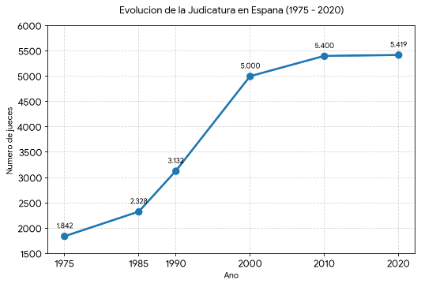
Public employment underwent a transformation: the system shifted toward the strict constitutional principles of Article 103.3 of the Spanish Constitution—equality, merit, competence, and transparency. The number of public employees rose from fewer than 700,000 in 1975 to 1,393,340 in 1990.
The legalization of sector-based unions (CC.OO. and UGT) and the emergence of occupational unions such as CSIF transformed the former “servants of the regime” into workers with full rights to collective bargaining.
3. Historical Memory and Case Law: Unresolved Issues
The evolution of legislation in Spain reveals a stark contrast between the urgency of achieving immediate social peace in 1977 and the subsequent need for moral and historical redress. The 2007 Historical Memory Act and the subsequent 2022 Democratic Memory Act have not dispelled the core of the criticism leveled by the international community and human rights organizations: judicial barriers that prevent the criminal prosecution of crimes against humanity committed during the dictatorship persist.
In the realm of case law, Spanish courts have played a markedly conservative yet stabilizing role. The Constitutional Court, through landmark rulings such as STC 147/1986, established in its doctrine that transitional amnesties are fully constitutional provided they function as an “exceptional instrument of pacification necessary for social peace,” elevating the 1977 model to a paradigmatic benchmark. At the same time, the Third Chamber of the Supreme Court (STS 1229/2019) upheld the exhumation of dictator Francisco Franco from the Valley of the Fallen, prioritizing collective democratic dignity over the rights of his private heirs and thereby consolidating administrative case law that has also strictly mandated the removal of all symbols glorifying the dictatorship from all local public spaces.
Conclusion
An analysis of the Spanish case offers a lesson for debates on Venezuela’s future: the transformation of the state and institutional structures of an authoritarian regime can be carried out with complete success if a gradual, long-term approach is adopted and the independence of public employees and judges is guaranteed. To this end, a model of access based on merit and competence, job security, adequate compensation, and independence to curb the discretionary and arbitrary exercise of power are essential. It is not necessary to address all institutional challenges simultaneously, especially when there is an existing legal framework upon which to base the change—as is also the case in Venezuela. The goal is to sever the ties that bind these actors to the executive branch and guarantee their genuine independence.
Zulima Sánchez Sánchez, The Paradox of the Spanish Transition, 10. July 2026, ICCAL Blog, https://iccal.lat/en/blog/the-paradox-of-the-spanish-transition/
Authors