20. August 2026
Victims’ Participation in Transitional Justice: Lessons from Guatemala for Reflecting on the Transition in Venezuela
This blog post was translated from the original Spanish version by using AI tools.
If you encounter any errors, please contact us.
Reflecting on the democratic transition in Venezuela requires looking beyond traditional approaches focused exclusively on formal or institutional spaces. As outlined by the Ius Constitutionale Commune in Latin America (ICCAL) framework, rebuilding the conditions for a democratic society requires integrating law, politics, institutions, and practical feasibility, while recognizing local spaces of democratic resilience. In this endeavor, comparative experiences offer useful tools, warnings, and lessons for reflection. Guatemala, considered a paradigmatic case of transitional justice, sheds light on a crucial dimension in debates about transitions: the participation of victims.
Victims-Survivors as Central Actors in Transitional Justice
Guatemala endured 36 years of internal armed conflict (1960–1996), marked by massive and systematic human rights violations, including crimes against humanity and acts of genocide, in which the Maya people accounted for 83% of the victims. In this context, victims have been key actors in shaping, driving, and sustaining transitional justice processes, often in the face of weak political will on the part of the state, structural impunity, and deep-rooted historical inequalities.
Unlike other contexts, Guatemala never adopted a framework law on transitional justice. Many of the mechanisms that emerged following the signing of the Peace Accords in 1996 were the direct result of the mobilization of victims’ organizations, affected communities, and human rights organizations. Organized victims, in particular, have played an active role in defining priorities, shaping agendas, and creating spaces for political and legal advocacy.
Their strategic participation—especially that of the Maya people—was decisive in expanding the mandate of the Commission for Historical Clarification, establishing the National Reparations Program (PNR), and bringing to trial landmark cases of serious human rights violations involving genocide and crimes against humanity, both at the national level and before the Inter-American Human Rights System (IHRS). In particular, the rulings of the Inter-American Court of Human Rights in cases involving massacres, torture, and enforced disappearance, among others, have been key to domestic mobilization: to denounce patterns of violence, advance criminal investigations, demand comprehensive reparations, and promote the creation of mechanisms to search for missing persons.
However, beyond the development of institutional mechanisms, the Guatemalan experience shows that transitional justice does not emerge solely from the state. It can also be built at the local level through processes of collective mobilization that take advantage of legal and political opportunities to advance their demands for justice.
Participatory Pathways Beyond Formal Mechanisms
An analysis of these participatory trajectories using a stakeholder-based approach reveals grassroots mobilization in both formal and informal spaces. Victims’ collectives—organized within broader social movements such as women’s, Maya, and anti-corruption movements—have built alliances with other civil society actors who have served as supporters in these processes.
Their repertoire of collective action has combined, on the one hand, legal mobilization—such as participating as joint plaintiffs in criminal proceedings (which is key to presenting evidence, building cases, and following up on them), engaging the Inter-American Human Rights System (IHRS) in the face of a lack of political will, and pursuing constitutional and administrative actions. On the other hand, victims drive sociopolitical mobilization through social protests and advocacy activities that link art with demands for justice.
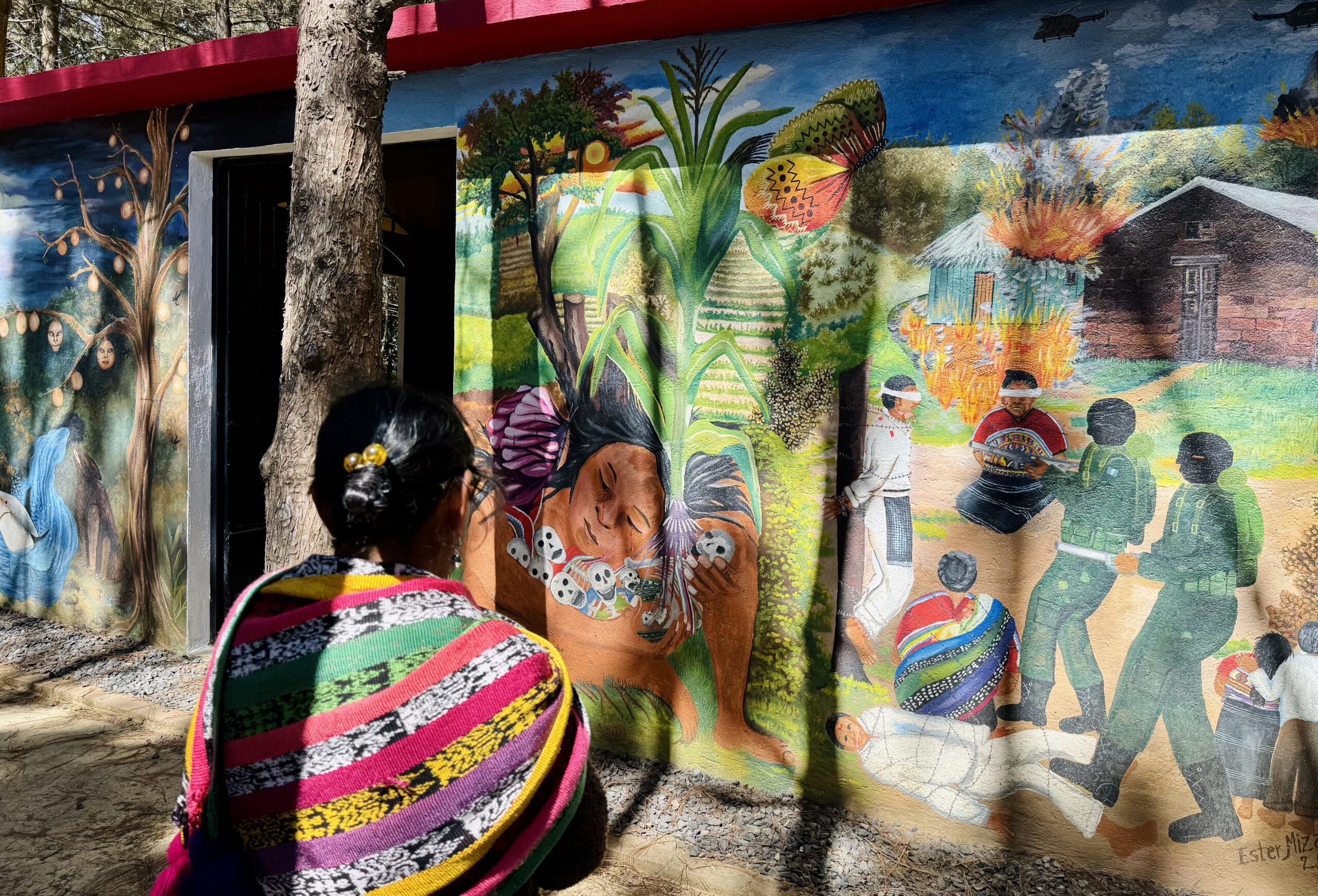
At the same time, and in many cases in response to the limitations of state mechanisms, grassroots mobilization has led to the creation of alternative spaces for justice, for example: community exhumation processes, practices for documenting and archiving human rights violations, truth-building at the local level (oral histories, courts of conscience), spaces of memory such as murals, monuments, and community museums, and local healing practices with a psychosocial focus.
These practices not only constitute spaces of solidarity and resistance in the face of a lack of political will, but they also broaden the scope of transitional justice and challenge overly legalistic approaches. Affected communities often articulate their own conceptions of harm and reparations, incorporating cultural, spiritual, territorial, and collective dimensions that are not always recognized within traditional institutional frameworks.
Tensions, Unresolved Issues, and Challenges
The Guatemalan case also highlights significant tensions between symbolic participation and effective participation. The PNR is a clear example: its gradual dismantling, along with that of other peace institutions, and an approach focused on financial compensation without genuinely transformative measures to address the structural causes of the conflict, led to dissatisfaction and participatory fatigue. , neither a mechanism for searching for disappeared persons nor a single registry of victims was established. Regarding guarantees of non-repetition, there was no comprehensive agrarian reform; racism and discrimination persist; and constitutional reform regarding justice and legal pluralism failed. Furthermore, the role of economic actors in the armed conflict remains invisible due to the power they still wield in the country.
Added to this are the crisis of independence within the judiciary, the criminalization and intimidation of victims, witnesses, and judicial officials, malicious litigation in criminal proceedings, denialist and stigmatizing narratives, and the lack of resources to ensure the sustainability of local institutions.
Even so, thirty years after the peace agreement was signed, transitional justice remains a paradigm championed by society: to advance contemporary justice priorities such as intergenerational dialogue, the preservation of historical memory through local community spaces, as well as the creation of new formal spaces, such as the 2026–2036 Reparation and Dignification Plan.
Lessons for the Venezuelan Case
What does this experience contribute to our thinking about the transition in Venezuela? First, the need to rethink transitional justice—moving beyond an approach focused exclusively on formal institutions to one that values the agency of victims, their own forms of organization, and their situated conceptions of justice. Second, the contingent nature of transitional justice—marked by moments of openness and closure—which demands a strategic and creative mobilization of legal and political opportunities. Third, the importance of designing participatory mechanisms with intersectional and comprehensive approaches that also avoid reproducing hierarchies and fragmentation within the victims’ own communities. Fourth, national and international partners—such as donors, academia, and human rights organizations—are key to sustaining locally anchored processes, which require a shift from paternalistic approaches that merely “give voice” to ethical practices of co-creation and horizontal collaboration.
Despite mixed experiences, security risks for victims, and participatory fatigue after decades of mobilization, Guatemala demonstrates the enduring resilience of victims, who continue to drive agendas related to memory, intergenerational dialogue, and reparations. For Venezuela, the central lesson is that a legitimate and sustainable transition must be built in partnership with victims and affected communities, who have historically been at the center of the struggles for truth, justice, and dignity.ebe construir en conjunto con las víctimas y las comunidades afectadas, quienes han estado históricamente en el centro de las luchas por la verdad, la justicia y la dignidad.
Gretel Mejía Bonifazi, Victims’ Participation in Transitional Justice: Lessons from Guatemala for Reflecting on the Transition in Venezuela, 20. August 2026, ICCAL Blog, https://iccal.lat/en/blog/participacion-victimas-justicia-transicional-guatemala-venezuela/
Authors