17.09.2026
A Commemoration of the 25th Anniversary of the Inter-American Democratic Charter
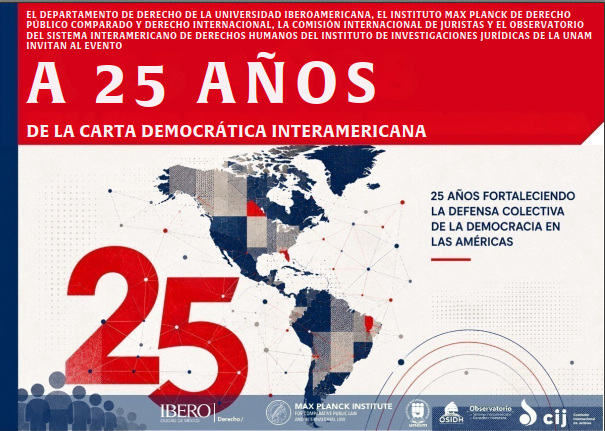
On September 11, 2026, exactly a quarter of a century after its adoption in Lima, the Max Planck Institute for Comparative Public Law and International Law (MPIL), the Law Department of the Universidad Iberoamericana, the Observatory on the Inter-American Human Rights System of the UNAM Institute for Legal Research, and the International Commission of Jurists organized, in a hybrid format, the event “25 Years of the Inter-American Democratic Charter.” The event brought together the Secretary General of the Organization of American States (OAS), Albert Ramdin, along with representatives of the Inter-American Court and Commission on Human Rights, to highlight the instrument’s contribution to the defense of democracy in the hemisphere.
Article 1 of the Charter states that the peoples of the Americas have the right to democracy, and Part I is entirely devoted to the relationship between democracy and the Inter-American System. The analysis of the Charter’s value for the development of standards regarding democratic society revolved around this central theme, as Mariela Morales Antoniazzi noted.
Voices from the Inter-American System Pay Tribute to the 25th Anniversary of the Inter-American Democratic Charter
The presentations provided an overview of the role of the Inter-American Democratic Charter for the System’s organs within the scope of their respective jurisdictions. Rodrigo Mudrovitsch and Verónica Gómez, president and judge of the Inter-American Court of Human Rights, respectively, highlighted the milestone the Charter represented in the corpus iuris by clarifying its normative and legal scope, its role as an instrument for the authentic interpretation of the OAS Charter, and its increasing invocation in the decisions of the Inter-American Court. Andrea Pochak and José Luis Caballero, first vice president and second vice president of the Inter-American Commission on Human Rights, joined the discussion, referring not only to the Charter’s origins but also emphasizing the current context and challenges facing democracy in the Americas. Eduardo Ferrer Mac-Gregor, former president of the Inter-American Court of Human Rights and member of the International Commission of Jurists, highlighted that the Charter is an expression of common principles and values for the states of the hemisphere and serves as a regional framework for democracy, rights, and the rule of law. For her part, Antonia Urrejola, in her capacity as former president of the Inter-American Commission and former foreign minister of Chile, reflected on the Charter’s perspective on the past and the future, warning of emerging risks and the challenge of confronting the erosion of democracy. The closing remarks by Edison Lanza, Ambassador of the Republic of Uruguay to the OAS, in light of the progress achieved thanks to the Charter, called for recognition of its symbolic significance and continued relevance 25 years after its adoption by acclamation.
Closing remarks: judicial independence and the socioeconomic dimension
Alongside the remarks by María Elisa Franco Martín del Campo, Coordinator of the Observatory on the Inter-American Human Rights System at the IIJ-UNAM, who summarized the speakers’ consensus regarding the principles established under the Charter, Mariela Morales Antoniazzi, from the ICCAL’s perspective, reiterated the significance of the Inter-American Democratic Test (TDI), offering a doctrinal reconstruction that articulates three pillars of the Inter-American Democratic Charter: Articles 3 and 4, which establish the essential elements of democracy and the fundamental components for its exercise, including judicial independence as a structural guarantee of the rule of law; Articles 7 and 8, which enshrine a dual conditionality between democracy and human rights—interdependent categories that reinforce one another; and Articles 9 through 15, which incorporate the socio-environmental dimension as constitutive, rather than merely programmatic, features of a democratic society.
See Morales Antoniazzi and Berg, “Judicial Independence as a Dimension of the Inter-American Democratic Test” (MPIL Research Paper No. 2026-10, August 26, 2026).