This fellowship, led by Professor René Urueña, examines the role of communities of practice in the production and circulation of transnational legal knowledge on human rights in Latin America. It starts from the premise that the advancement of the Latin American ius commune in human rights does not depend solely on laws, treaties, or judicial decisions, but also on living networks of actors who interpret, apply, and reshape the law within their local and regional contexts.
These communities, composed of judges, scholars, lawyers, activists, and public officials, generate spaces for exchange in which professional experience, shared methods, and legal concepts evolve into a common language of human rights. The research explores how, through academic forums, strategic litigation, legal clinics, digital platforms, and training initiatives, these actors create, circulate, and apply legal knowledge that transcends national borders.
By studying these dynamics, the project seeks to understand the conditions that enable such ideas to travel between national and inter-American legal systems, and how they translate into concrete institutional reforms and administrative practices. Developed within the framework of the Max Planck Law Fellowship at the Max Planck Institute for Comparative Public Law and International Law (Heidelberg), this study proposes a dynamic and decentralized understanding of transformative constitutionalism as a social process of learning, interaction, and professional collaboration.
Project members
René Urueña
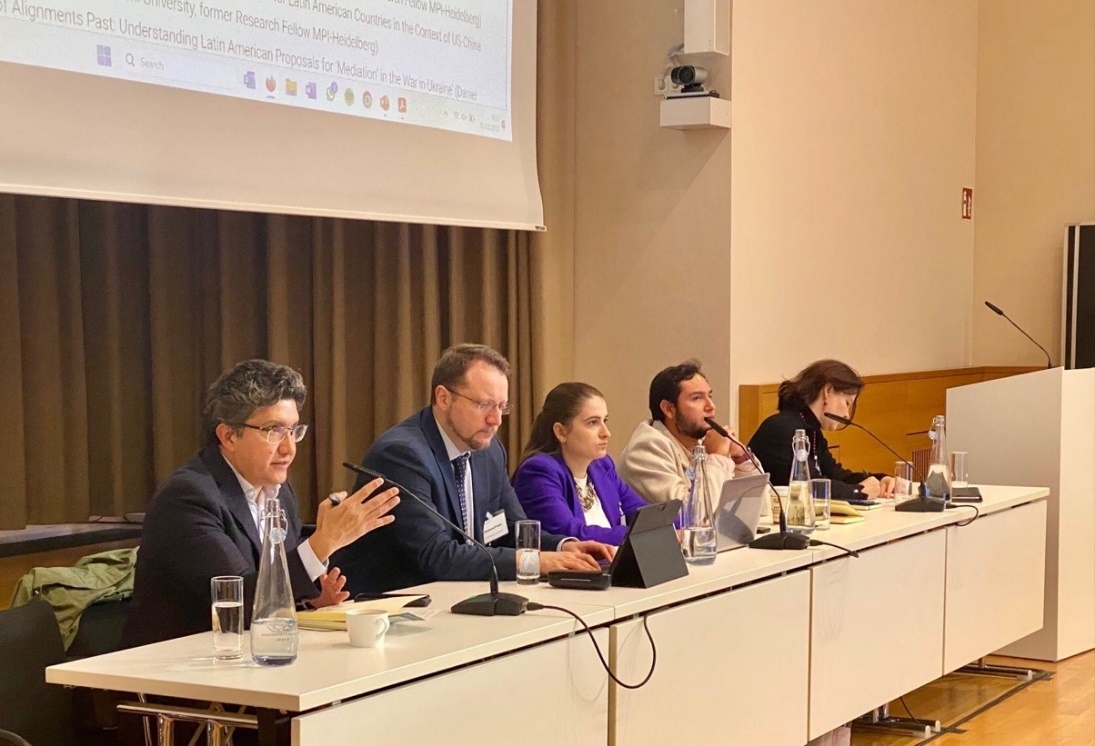
The project offers a critical and realistic vision of transformative constitutionalism, understood as a collective process that emerges from the everyday practices of legal and social communities. Rather than locating legal change exclusively within courts or legislation, it emphasizes that transformation also arises in spaces where law is discussed, taught, and applied. By sharing experiences, strategies, and interpretations, these communities of practice renew the meaning of human rights and strengthen the legitimacy of the Latin American ius commune. In doing so, the fellowship highlights how transnational cooperation and dialogue among professionals can translate shared legal knowledge into concrete and sustainable institutional change.
