25.02.2026
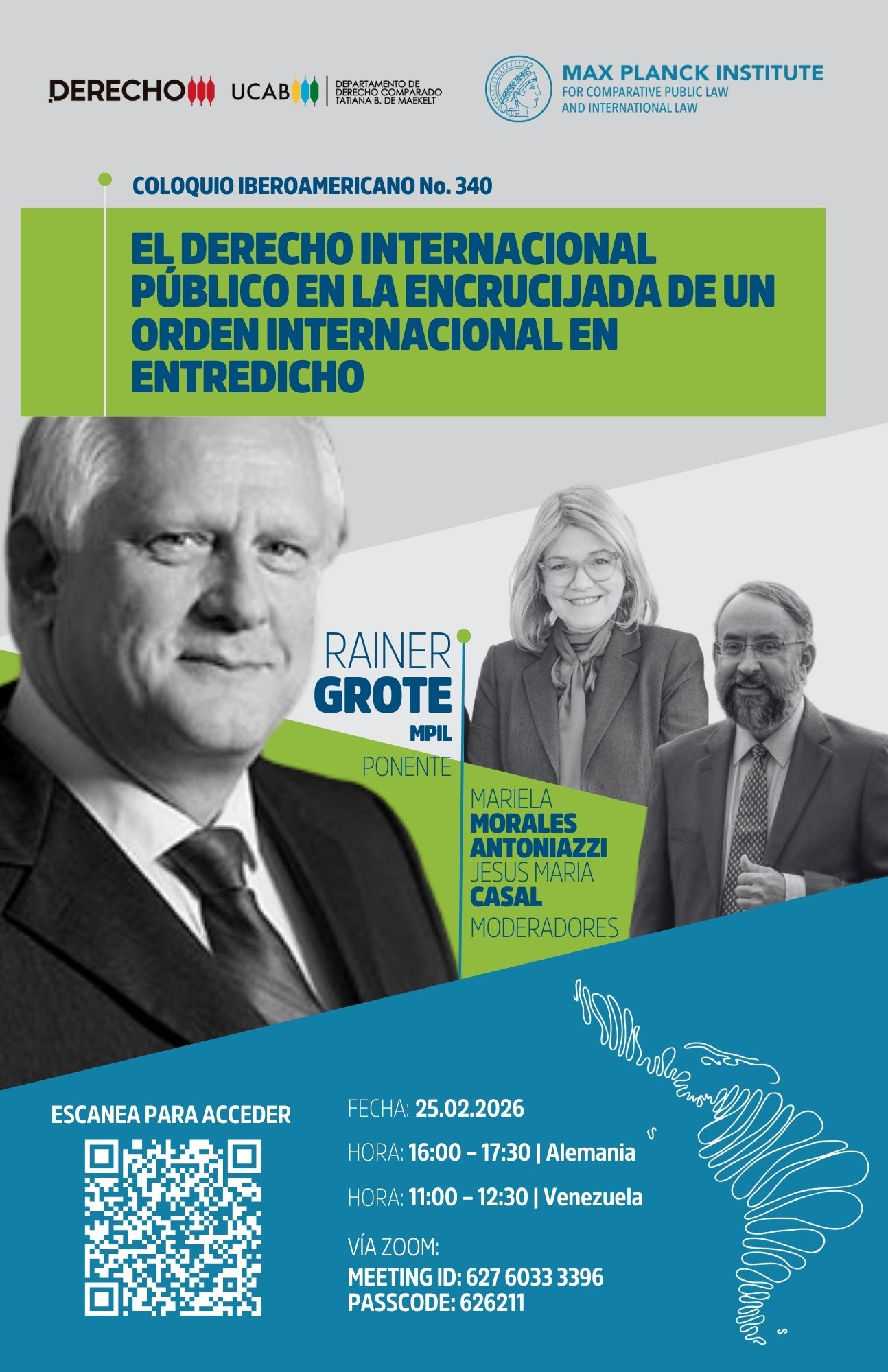
Ibero-American Colloquium- No. 340: International Public Law at a Crossroads in a Contested International Order
Rainer Grote offered a historical and contemporary reflection on the development of international public law and the current challenges facing the international legal order.
25 February 2026, MPIL Heidelberg
The Max Planck Institute for Comparative Public Law and International Law held a new session of its Ibero-American Colloquium series under the title “El derecho internacional público en la encrucijada de un orden internacional en entredicho”. The event also marked the inaugural activity of the Department of Comparative Law of the Faculty of Law of the Universidad Católica Andrés Bello, under the direction of Professor Jesús María Casal.
In his opening remarks, Dean César Carballo emphasized the importance of comparative law as a tool for academic dialogue and exchange in a complex international context, as well as the institution’s commitment to internationalization and the promotion of the rule of law.
Historical evolution of the international order
In his lecture, Professor Rainer Grote examined the development of international public law since the early twentieth century, with particular attention to the role of major powers in shaping its foundations.
The presentation recalled the significance of the Fourteen Points proposed by Woodrow Wilson as an important reference in the emergence of a normative conception of the international order, as well as the subsequent establishment of the League of Nations and, after the Second World War, the United Nations.
Special attention was given to the fundamental principles enshrined in the UN Charter, including sovereign equality, the peaceful settlement of disputes, and the prohibition of the use of force, as well as to the gradual development of the international human rights system through the Universal Declaration and various multilateral treaties.
Practice and institutional development
Professor Grote noted that the evolution of the international order has been accompanied by debates and challenges in its implementation. He addressed different historical moments in which State practice has raised questions regarding the relationship between national interests and international commitments.
He further observed that foreign policy orientations may vary depending on domestic political contexts and governmental priorities, which in turn can influence approaches to international law.
Within this framework, the lecture examined the role of the United States throughout the twentieth and early twenty-first centuries, both in the institutional construction of the multilateral system and in ongoing discussions about its functioning and scope.
Contemporary challenges and cooperative perspectives
In the final part of his presentation, the speaker reflected on current developments affecting the international legal order, including political polarization in certain contexts and its potential implications for international stability.
As a possible avenue for continuity and strengthening of international law, Professor Grote highlighted the importance of cooperation among States committed to multilateral engagement, as well as the formation of joint initiatives to address specific global issues, including international security and environmental protection.
The session concluded with a discussion period, allowing participants to further explore the themes addressed and reaffirming the relevance of the Ibero-American Colloquium series as a forum for academic reflection on international public law and its ongoing transformations.