The Tandem Group was created in 2017 at Universidad de los Andes (Colombia) in cooperation with the Max Planck Institute for Comparative Public Law and International Law, as the first social sciences Tandem Team established within the Max Planck Society.
Its mission was to explore the role of civil society and social movements in consolidating democracy, the rule of law, and human rights in Latin America. Using an ethnographic approach rooted in legal anthropology, the group examined how international human rights law is invoked, redefined, and localized in contexts of social struggle.
Two emblematic case studies guided the research: in Buenaventura, Black communities organized under the Proceso de Comunidades Negras (PCN) resisted port expansion by appealing to multicultural human rights discourses; in Cartagena, Afro-descendant communities defended ancestral lands against urban development and tourism, creating local legalities through international law. These experiences showed that international norms are not confined to courts or international bodies but are reshaped from below in local arenas.
The Tandem Group also created spaces of dialogue between academia and practice, notably through conferences such as the CAPAZ discussion event on international human rights law in Latin America, which featured guest lectures from Carolina Bejarano, Joaquín Garzón, and Miguel Rábago Dorbecker. This seminar explored how human rights discourses operate simultaneously at the local and transnational scales, and how truth commissions and the Inter-American System interact in shaping the “right to truth” and accountability practices in the region.
By combining clinical teaching, litigation strategies, and critical research, the Tandem Group trained new generations of jurists and offered both academic reflection and practical contributions to the inter-Americanization of law in Latin America.
Project members
PhD researchers:
Joaquín Garzón
Carolina Bejarano Martínez
Group leader:
Miguel Rábago Dorbecker (Universidad de los Andes – MPIL)
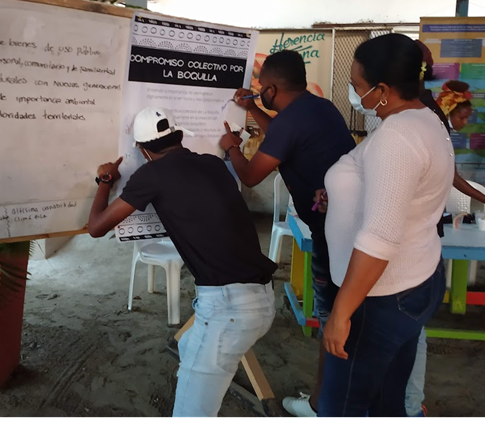
The added value of this project lies in its dual nature: both an academic space for reflection and a practical actor directly contributing to democratic resilience and the ius commune. Through litigation strategies, legal clinics, and close interaction with communities, the Tandem Group demonstrated that transformative constitutionalism emerges not only in courts, but also in the lived practices of marginalized groups defending their rights.
The project concluded in 2022 with three key outputs: the doctoral dissertations of Joaquín Garzón (Buenaventura) and Carolina Bejarano (Cartagena), and a policy paper for the Inter-American Commission on Human Rights on race and equality.
La respuesta del Ius Constitutionale Commune a la autocratización
La jurisdicción constitucional en América Latina.